
Carpenter ants don't eat wood. They move into wood that's already wet.
That distinction matters, because it tells you where to look. Black carpenter ants excavate galleries in moisture-damaged wood to nest, which means a persistent indoor population is usually pointing at a water problem — a failed flashing, a leaking window, a damp sill. We treat the ants and identify the condition that invited them.
Signs of an active colony
Carpenter ants leave more evidence than most people realize.
- Coarse sawdust pilesFrass — wood shavings mixed with insect fragments — accumulating below trim, sills, or ceiling junctions. Unlike termite damage, carpenter ant galleries are clean and smooth, and the shavings get pushed out.
- Large ants indoors in winterOccasional ants outside in summer can be foragers from a yard nest. Ants active indoors during cold months almost always mean a nest inside the structure.
- Faint rustling in wallsActive galleries in a quiet room can be audible, particularly at night in wall voids and ceiling cavities.
- Winged swarmers indoorsReproductives emerging inside in spring indicate a mature colony that has been established for several years.
- Moisture damageRoof leaks, ice dam damage, failed window flashing, damp crawl spaces, and wood-to-soil contact are where colonies start.
- Trailing along structural linesAnts moving in consistent lines along foundation edges, utility lines, deck ledgers, and overhanging branches that touch the roof.
Our carpenter ant process
- Locate the nest, not just the trailFollowing foraging trails back to harborage is the whole job. Treating the ants you can see without finding the nest produces a few quiet weeks and then a return.
- Check parent and satellite coloniesCarpenter ants commonly maintain a parent nest outdoors — in a stump, tree, or woodpile — and satellite nests inside the structure. Both need addressing.
- Non-repellent chemistryWe use non-repellent products and baits that foraging ants carry back and transfer through the colony. Repellent sprays scatter colonies and can split them into new nests.
- Treat voids directlyWhere galleries are accessible, we treat harborage voids directly rather than relying on surface application alone.
- Address the moistureWe document the water source that made the wood habitable. Without that correction, another colony finds the same spot.
Carpenter ants versus termites
Both damage structural wood and both swarm in spring, so they get confused constantly. Carpenter ants have a pinched waist, elbowed antennae, and unequal wing pairs; termite swarmers have a straight body, straight antennae, and four wings of equal length. Carpenter ant galleries are smooth and clean; termite galleries are packed with soil. If you've collected swarmers, save a few — identification changes the entire treatment plan.
Why repellent sprays make it worse
Over-the-counter perimeter sprays are repellent by design. Applied to an established carpenter ant colony, they can trigger budding, where the colony splits and relocates into multiple new nesting sites. Homeowners often call us after a season of self-treatment with a bigger problem than they started with. Non-repellent chemistry works the opposite way — ants walk through it and share it.
Where we provide this service
Northport, East Northport, Huntington, Halesite, Centerport, Greenlawn, Cold Spring Harbor, Fort Salonga, and the surrounding North Shore communities. See all service areas.
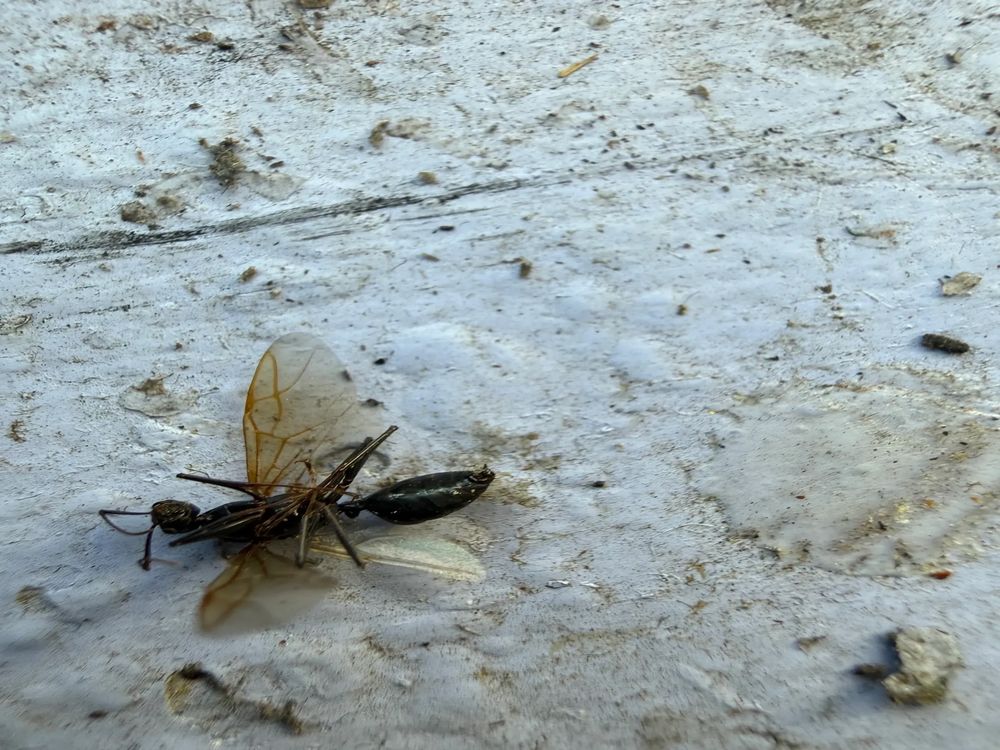
What this looks like in the field
Photos from actual jobs on the North Shore.
Had a serious carpenter ant problem along my foundation and inside my garage. Steve came out within a day, did a full inspection, explained exactly what was attracting them and where they were nesting, and treated both inside and out. What I appreciated most was that he didn't just spray and leave — he took the time to show me what conditions to fix to prevent them from coming back. No hard sell, no unnecessary chemicals. Two weeks later, the problem is gone. Refreshing to deal with an owner-operated business where the guy actually knows his stuff.
Not sure what you're dealing with?
Send a photo by text and we'll tell you what it is. Identification is free, and it's the step that determines everything else.